Critical Legal AI Literacies: The Challenges of Synthetic Media
Clifford Anderson speaks on synthetic media as part of the Lillian Goldman Law Library's Critical Legal AI Literacies series.
•
1 min read
Clifford Anderson speaks on synthetic media as part of the Lillian Goldman Law Library's Critical Legal AI Literacies series.
This chapter examines how gender bias becomes encoded in digital knowledge infrastructures, taking the representation of women in religion as a case study.
'Deepfakes,' synthetic media generated by deep neural networks, have become increasingly common in many sectors, from social media, edtech, and business marketing to museum …
The Computational Theology Lab at Yale Divinity School explores the intersection of computational methods and theological inquiry. As founder, Clifford Anderson leads research …
Vanderbilt Divinity School and the Heard Libraries announce a $350,000 NEH grant to make English translations of Syriac literature freely available online.
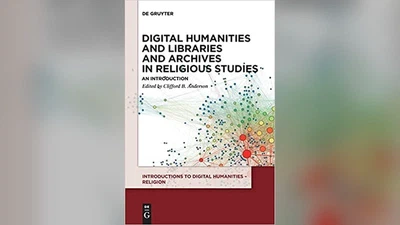
How are digital humanists drawing on libraries and archives to advance research and learning in the field of religious studies and theology? How can librarians and archivists make …
Edmund Husserl described the act of remembering as essentially curatorial: we judiciously relive past 'nows' to hold onto significant experiences, allowing everything else to fade …
How should theological librarians develop computational literacy—for themselves and for their communities? This chapter argues for cultivating computational thinking rather than …
The goal of the project is to develop and implement interactive learning pathways for information professionals to learn the fundamentals of WikiCite.
This contribution to a collection of short essays on teaching with digital humanities describes Mapping Berlin, a collaborative course and digital project at Vanderbilt University …